In a world obsessed with perfection, the Wabi-sabi small-footprint villa offers a quiet rebellion. This compact home of just 70 square meters does not seek to impress through symmetry or shine, but through authenticity, age, and natural imperfection. Rooted in the Japanese philosophy of finding beauty in transience and flaw, the design celebrates raw materials, irregular textures, and the gentle patina of time. This is not a sterile showpiece; it is a living, breathing sanctuary that grows more beautiful with every scratch, fade, and crack.
Design Concept: The Art of Incompleteness
The design rejects the minimalist mantra of "everything in its place" in favor of a more organic, intuitive arrangement. Spaces are intentionally left "unfinished" — a wall with visible trowel marks, a ceiling beam with natural warping, a floor with subtle unevenness. The layout is asymmetrical and flowing, without sharp corners or rigid partitions. Natural light enters through irregularly placed, small, deep-set windows, creating shifting shadows that become part of the decor. The guiding principle is kintsugi thinking: every flaw is not hidden but honored. Storage is minimal and open, using woven baskets and reclaimed wood shelves.
Style: Rustic, Earthy, and Poetic
The Wabi-sabi style here is defined by a muted, earthy palette: warm clay, faded olive, weathered charcoal, aged brass, and the white of old paper. There are no bright colors or glossy finishes. Textures are rough, tactile, and varied — raw plaster, unpolished stone, unfinished wood, and coarse linen. Decorative objects are few but deeply meaningful: a hand-thrown ceramic bowl with a crack, a dried branch arranged in a glass vase, a single calligraphy brush. The overall feeling is calm, humble, and slightly melancholic — like an old haiku.
Materials: Raw, Natural, and Aging Gracefully
Materials are chosen for their honesty and how they change over time:
Floors: Troweled, natural-earth clay plaster (or polished concrete with aggregate visible) in a soft, warm grey-brown. The surface is intentionally uneven, with slight cracks and color variations.
Walls: Lime-washed plaster with visible brushstrokes and subtle undulations. One accent wall in the living room is left as raw, unpainted concrete with formwork marks.
Ceilings: Exposed, hand-hewn wooden beams in dark, aged oak, with woven bamboo mats (yoshizu) laid between them.
Accents: Reclaimed barn wood for shelving and the bathroom vanity. Hand-forged, blackened iron for handles and light fixtures. Aged brass for faucets.
Textiles: Unbleached, slubby linen; hand-woven cotton with loose threads; raw wool; and faded indigo-dyed fabrics.
Living Room: The Heart of Silence
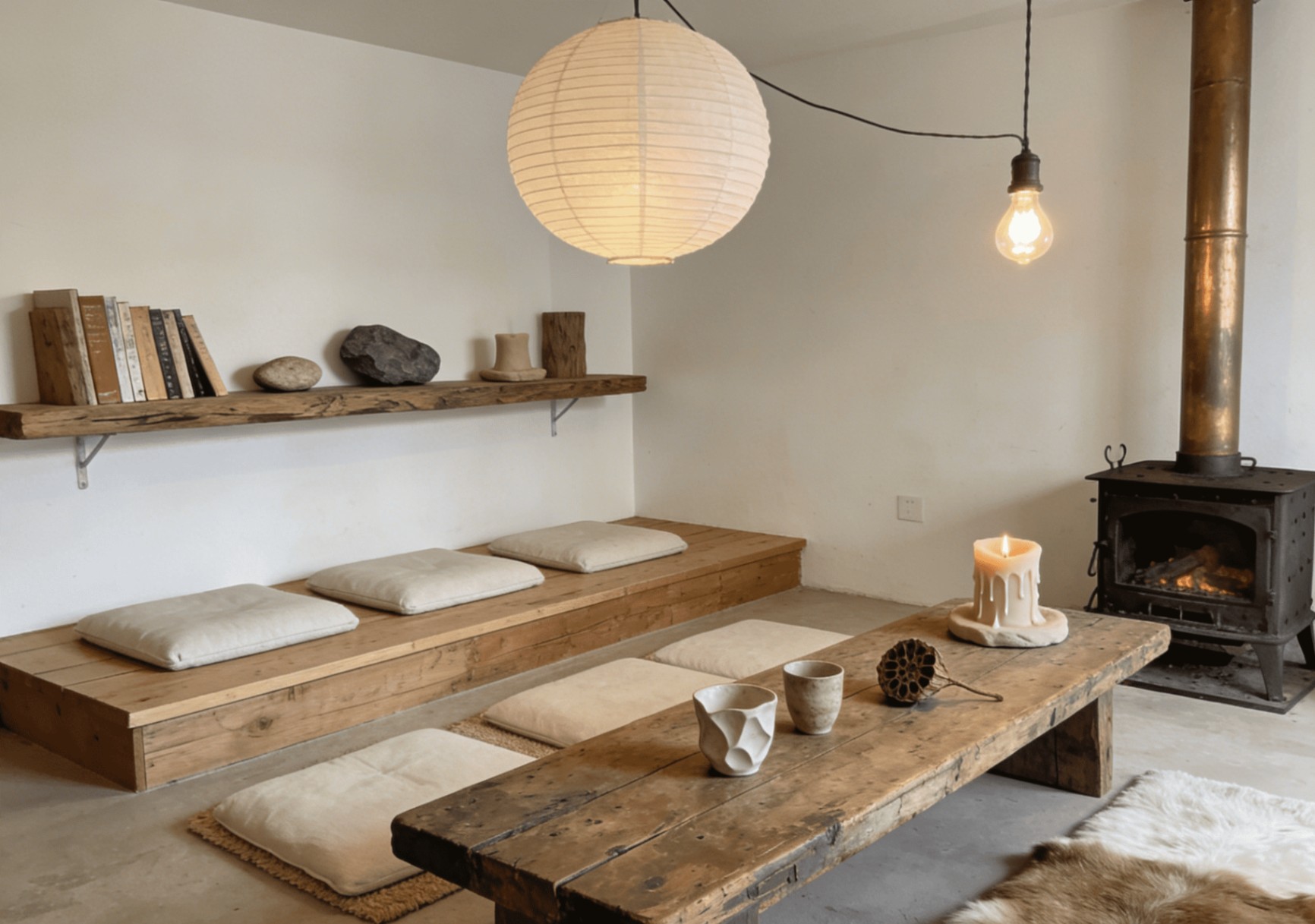
The living room is centered around a low, hand-built platform of reclaimed wood, topped with a simple cotton floor cushion and a sheepskin. There is no conventional sofa. Instead, a long, low table (a repurposed antique door) serves as both coffee table and dining surface. On it sits a single, irregular ceramic cup and a dried lotus pod. The fireplace is a small, cast-iron kotatsu-style brazier, with a handmade copper flue. Shelves are rough-hewn wood brackets holding a few books with worn spines, a stone found on a walk, and a candle melted into a clay saucer. Light comes from a single paper lantern and a row of tiny, dim, bare bulbs on a twisted wire.
Bedroom: A Restful Cave
.jpg)
The bedroom feels like a quiet cave. Walls are finished with a dark, earthy clay plaster that absorbs light. The bed is a simple, low platform of raw oak with no headboard. Bedding is undyed, unbleached linen in natural grey and cream, slightly wrinkled on purpose. Instead of bedside tables, two stacked stones hold a small oil lamp and a cup of water. A single, small window is dressed with a hanging panel of raw silk, loosely tied. The closet is an open, sliding door made of a single sheet of rusted corrugated iron, behind which hang a few cotton kimonos. The only artwork is a blank, aged piece of washi paper framed in dark, unfinished wood.
Bathroom: The Rustic Bathhouse
.jpg)
The bathroom evokes an old Japanese bathhouse. Walls and floor are clad in small, irregular, hand-made clay tiles in varying shades of beige and grey, with no grout lines — just packed earth. The soaking tub (a ofuro) is a freestanding, unglazed ceramic vessel, dark charcoal in color, with a wood-burning copper coil to heat the water. The sink is a hollowed, polished stone set into a reclaimed wood counter, with a hand-forged iron spout that drips slowly (a deliberate, meditative sound). There is no mirror — only a small, dark, polished metal disk that offers a blurred reflection. A single, rough-hewn wooden stool holds a clay soap dish. Light is a single, tiny, wax-sealed paper lantern.
Kitchen: The Wabi-Sabi Hearth
.jpg)
The kitchen is minimal, rustic, and deeply functional. Cabinetry is non-existent; instead, open shelving made of rough, blackened oak holds a few earthenware pots, a cast-iron pan, and a mortar and pestle. The countertop is a single slab of unsealed, dark soapstone that will stain and scratch beautifully over time. The sink is a deep, hand-hammered copper basin with an aged brass faucet. There is no refrigerator — a small, clay-cooling cabinet (a zairyo) stores vegetables and pickles. The cooktop is a two-burner, cast-iron gas stove with visible pilot lights. Above it hangs a handmade copper exhaust hood with rivets. Utensils are made of wood, bamboo, and iron, hanging from a simple nail on the wall. The only "modern" appliance is a hidden, compact induction plate for safety, but it is kept out of sight.
Conclusion: Living with Impermanence
This Wabi-sabi small-footprint villa is not for everyone. It asks its residents to let go of the need for perfection, to accept cracks, stains, and fading as part of life's beauty. But for those who embrace it, the reward is profound: a home that feels ancient, peaceful, and deeply authentic. Every room — the poetic living room, the cave-like bedroom, the rustic bathhouse, and the humble kitchen — invites you to slow down, breathe, and find joy in the imperfect. It is a home that ages with you, gracefully.