Ancient Roman design was a synthesis of Greek elegance, Etruscan practicality, and imperial ambition — creating spaces that were grand, functional, and luxurious. In a small-footprint villa of just 75 square meters, this aesthetic transforms a compact home into a domus — a private, inward-facing sanctuary that celebrates engineering, art, and the pleasures of domestic life. The design philosophy is “magnificence within limits” — using architectural illusions (frescoes, mirrors, and spatial layering) to make small rooms feel larger, and focusing on high-impact materials like marble, mosaic, bronze, and terracotta. This is not a literal reconstruction of a Roman villa (which often sprawled around a courtyard), but a distilled essence: arches, columns, coffered ceilings, and a palette of warm terracotta, deep red (Pompeian red), gold, cream, and navy blue. The result is a home that feels like a tiny piece of Pompeii or a Roman emperor’s retreat — warm, dramatic, and timelessly elegant.
Design Concept: Architectural Illusion and Symmetry
The concept draws from Roman innovations: the arch, the vault, and the atrium (central light well). The layout is symmetrical, with a small, indoor impluvium (a shallow reflecting pool or a fountain) as the focal point, visible from multiple rooms. Key features include arched doorways and niches, a coffered or barrel-vaulted ceiling in the living room, and the use of trompe l’oeil frescoes to “open up” walls with painted architectural vistas. The palette is rich: Pompeian red, gold ochre, terracotta, cream, black, and touches of cobalt blue. Ornament is abundant but tasteful — mosaics on floors, frescoes on walls, and decorative stucco reliefs. The goal is to create a home that feels like a private Roman villa: intimate, luxurious, and full of art.
Style: Grand, Earthy, and Ornate
Ancient Roman style here is defined by arches, columns, and domes (or their smaller equivalents). Fluted columns or pilasters (Corinthian or composite capitals) frame doorways and corners. Floors feature geometric or figurative mosaics (black and white, or polychrome). Walls are divided into painted panels (fresco zones) with architectural details, mythological scenes, or still lifes. Furniture is heavy, carved wood (walnut, olive, cedar) with bronze fittings, or stone (marble) tables. The overall feeling is warm, opulent, and slightly theatrical. Patterns include acanthus leaves, egg-and-dart, guilloche, and geometric meanders. Accessories include bronze lamps, terracotta oil jars, marble busts, and glassware.
Materials: Luxurious, Durable, and Earthy
Materials are chosen for their authenticity and visual richness:
Floors: Polished, black-and-white marble mosaic (geometric patterns or a central emblem) or large terracotta tiles. In the bedroom, a herringbone pattern of dark walnut wood.
Walls: Painted fresco style: lower zones in deep Pompeian red or terracotta, middle zones in cream or gold with architectural motifs, upper zones in blue or black with birds and garlands. One wall may have a faux marble finish (scagliola). Alternatively, textured plaster in warm ochre.
Ceilings: Coffered wooden or plaster ceilings (recessed squares), painted in cream with gold details. In the living room, a shallow barrel vault (or faux vault) with painted clouds or a central medallion.
Windows/Doors: Arched wooden doors with bronze handles and iron hinges. Windows are tall, arched, with wooden shutters and sheer linen curtains. A small, circular oculus (skylight) may be added.
Columns: Fluted Corinthian pilasters (composite capitals with acanthus leaves) in painted wood or plaster, attached to walls.
Accents: Polished bronze, brass, and iron for hardware, lighting, and furniture. Marble (Carrara, red porphyry, green cipollino) for countertops and tabletops. Terracotta pottery.
Textiles: Heavy linen, wool, and velvet in deep red, gold, cream, and navy. Tassels and fringe.
Living Room: The Atrium & Tablinum
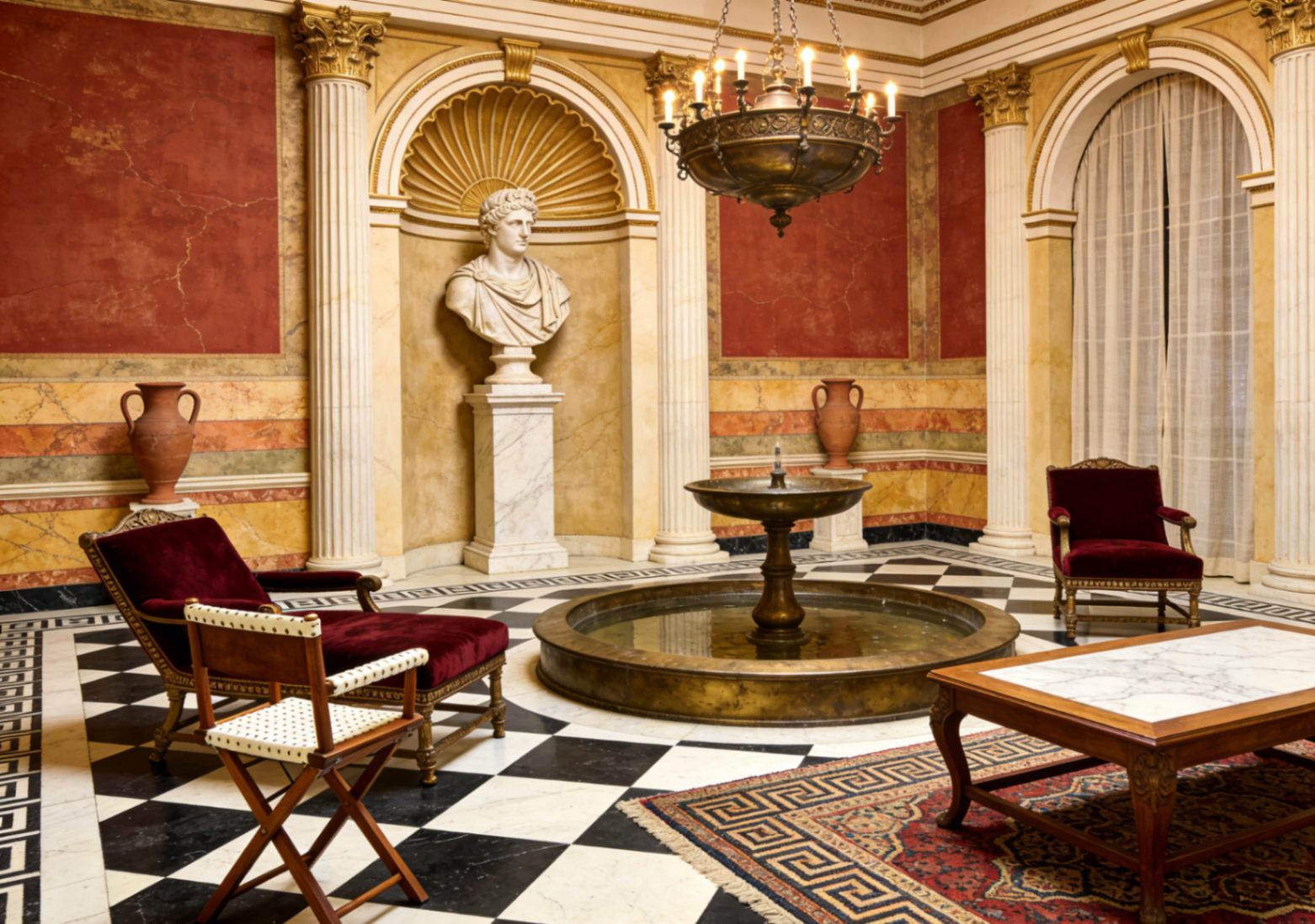
The living room combines the Roman atrium (reception area) and tablinum (office/gallery). The floor is a stunning black-and-white mosaic of a geometric labyrinth or a sea creature (dolphin) set in a cream border. A small, central impluvium (a low, circular fountain or a reflecting pool with a bronze fountainhead) adds the soothing sound of water. The focal wall features a large, arched niche with a marble bust of a Roman emperor or a goddess (Minerva or Venus), flanked by two fluted Corinthian pilasters. Seating includes a lectus (Roman-style daybed) upholstered in deep red velvet with bronze legs, and two curved, wooden armchairs (curule chairs) with ivory or bone inlay. The coffee table is a low, rectangular slab of white marble on a carved wooden base. A large, terracotta amphora stands in a corner. The walls are frescoed: lower red panels, a central band of architectural trompe l’oeil (columns and a distant garden), and an upper band of blue with birds. A bronze oil lamp (electric) hangs from the coffered ceiling. The window is arched, with wooden shutters and sheer, cream linen curtains. A wool rug in cream and navy blue with a Greek key border sits under the seating area.
Bedroom: The Cubiculum
.jpg)
Upstairs, the bedroom (cubiculum) is a warm, intimate chamber. The walls are painted in deep Pompeian red, with delicate, gold stenciled motifs of garlands and theatrical masks. The bed is a low, wooden platform with a tall, carved headboard (vine and acanthus motifs) and bronze finials. Bedding is white linen with a deep purple wool blanket (purple was the imperial color) and gold tasseled pillows. Bedside tables are small, round, marble-topped wooden tables, each with a bronze lamp shaped like a dolphin. Above the bed hangs a small, framed fresco panel (a portrait of a Roman couple or a mythological scene). The floor is dark walnut herringbone with a small, wool rug in red and gold. A freestanding, wooden armarium (wardrobe) with bronze doors and carved panels holds clothes. A single, bronze candelabrum stands in a corner. The window has wooden shutters and heavy, red velvet curtains with gold fringe. A small, terracotta incense burner releases a subtle scent of frankincense.
Bathroom: The Roman Bathhouse
.jpg)
The bathroom is a miniature Roman bath (balneum) — warm, steamy, and luxurious. Walls are clad in large, polished, cream limestone tiles, with a horizontal band of blue and green glass mosaic (fish and waves). The floor is a black-and-white pebble mosaic (a simple geometric pattern) with underfloor heating (hypocaust — simulated with electric radiant heat). A freestanding, white marble or ceramic, claw-foot tub sits on a raised, stone platform. The vanity is a marble slab with an integrated, white ceramic sink and a bronze, swan-neck faucet with cross handles. The mirror is a large, polished, bronze disk in a carved, wooden frame. The shower is a separate, walk-in enclosure with a bronze-framed, glass door and walls of white marble tile. Shower fixtures are polished bronze with a rain head and a handheld. A small, marble shelf holds a terracotta bottle of scented oil and a bronze strigil (curved scraper) — a nod to Roman bathing rituals. A small, bronze brazier (electric) provides warmth. A mosaic panel of a sea god (Neptune) decorates one wall. The toilet is wall-hung with a concealed cistern and a bronze flush plate.
Kitchen: The Culina
.jpg)
The kitchen (culina) is compact but functional, inspired by Roman domestic cooking spaces. Cabinetry is custom, in dark, oiled walnut with bronze, lion-head handles. Lower cabinets have open fronts with woven wicker baskets for storage. Upper cabinets are open shelving of walnut, displaying terracotta pots, glass bottles of olive oil and wine, and bronze cookware. The countertop is a slab of honed, dark grey slate or polished, red porphyry (or a marble lookalike). The sink is a deep, undermount, white ceramic basin with a bronze, pull-down faucet with a curved spout. The backsplash is a mosaic of small, iridescent glass tiles in gold and green. Appliances are integrated behind wooden panels, but a compact, gas-powered, enameled stove in cream with bronze knobs is visible (a retro-Roman style). Above the cooktop hangs a custom, bronze range hood with a scalloped edge, shaped like a Roman shield. A small, round, marble-topped, wooden table with two curule stools serves as a breakfast nook. A large, terracotta dolium (storage jar) sits on the floor, holding dried pasta or grains. Fresh herbs (bay, rosemary, thyme) in terracotta pots line the windowsill. A hanging, bronze rack holds wooden spoons, a mortar and pestle, and a bronze ladle.
Conclusion: Roma in a Small Space
This Ancient Roman style small-footprint villa proves that a compact home can capture the grandeur, art, and warmth of the Roman Empire. By embracing arches, columns, frescoes, mosaics, and rich materials — marble, bronze, terracotta, and deep reds — every room becomes a miniature masterpiece. The atrium living room, the cubiculum bedroom, the balneum bathroom, and the culina kitchen together create a home that feels like a private corner of Pompeii or a Roman emperor’s hideaway. It is a space for feasting, bathing, and the dolce far niente (sweet idleness) — Roman-style. Salve.